





Shipping Container Roof Ideas: Types, Sizes and Costs
A shipping container roof turns the empty space between two containers into a covered work area, garage or warehouse, without building a full structure from scratch. This guide compares the main roof ideas, shows how to choose the right size and breaks down real kit prices, so you know what to budget before you buy.
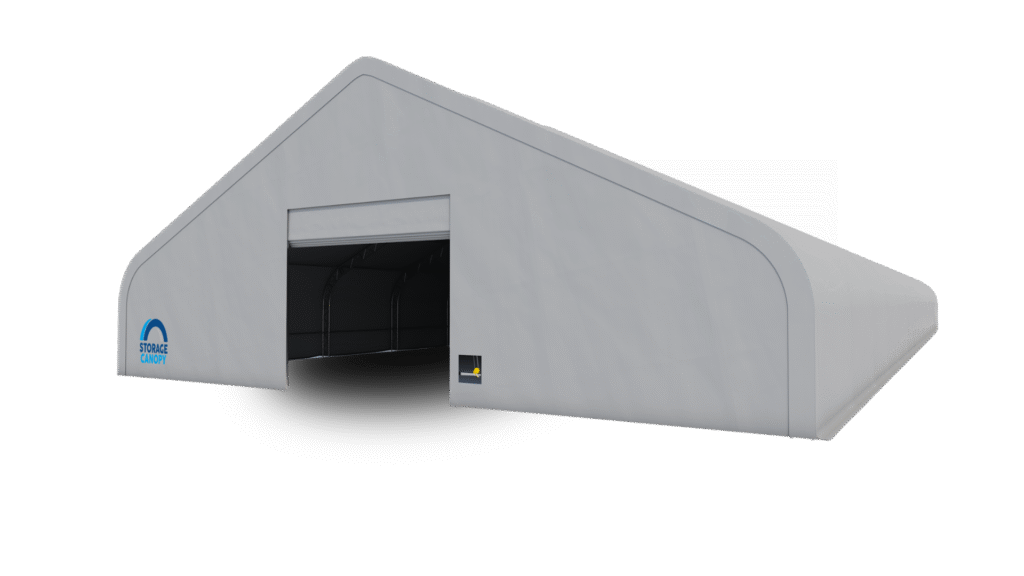
Quick answer: The most popular shipping container roof is a fabric roof kit: galvanized steel trusses that mount on top of two containers, covered with a heavy-duty PVC fabric. Kits come in widths from 20 to 60 ft and lengths from 20 to 80 ft. At Storage and Canopy they start at $1,629 for a 20 x 20 ft kit and go up to $25,520 for a 60 x 80 ft double truss shelter, with free shipping in the USA.
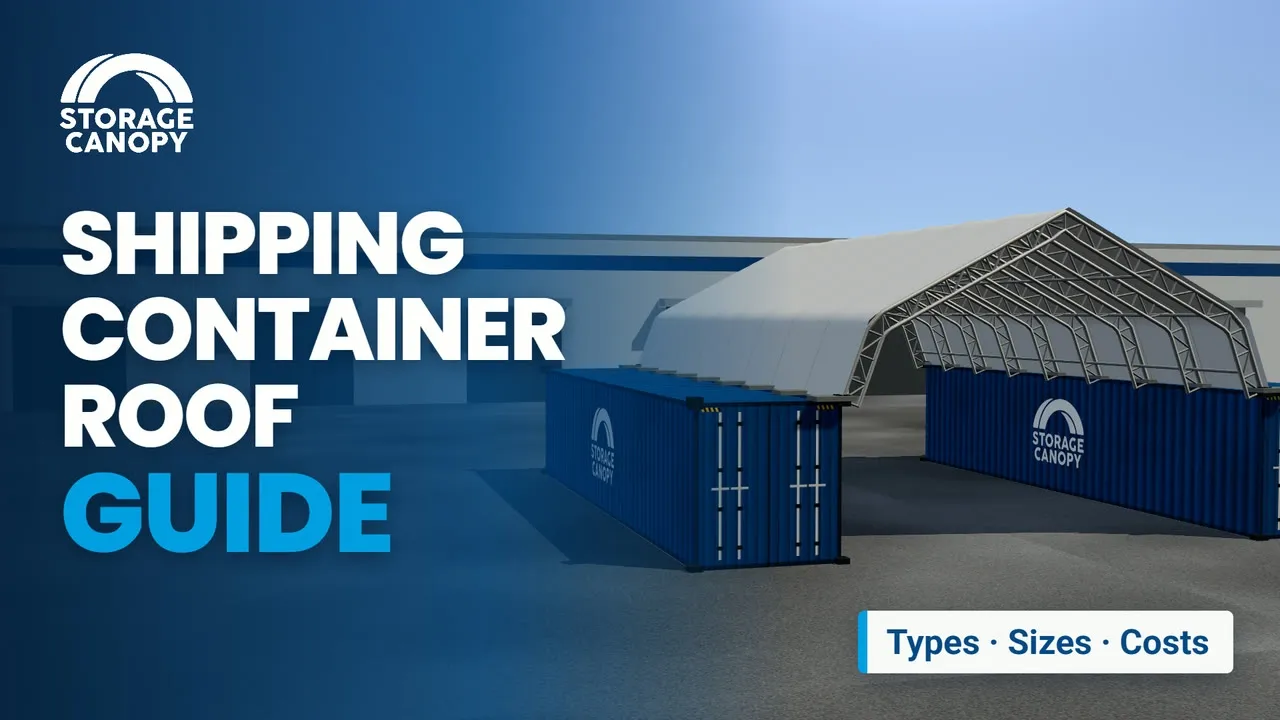
Watch: how a shipping container roof works (55 s)
In this guide
- What is a shipping container roof?
- 6 shipping container roof ideas
- How to choose the right size
- How much does a shipping container roof cost?
- How to install a roof between two shipping containers
- Wind, snow and local codes
- 5 mistakes to avoid before buying
- Common uses for a container roof
- Maintenance tips
- Frequently asked questions
What is a shipping container roof?
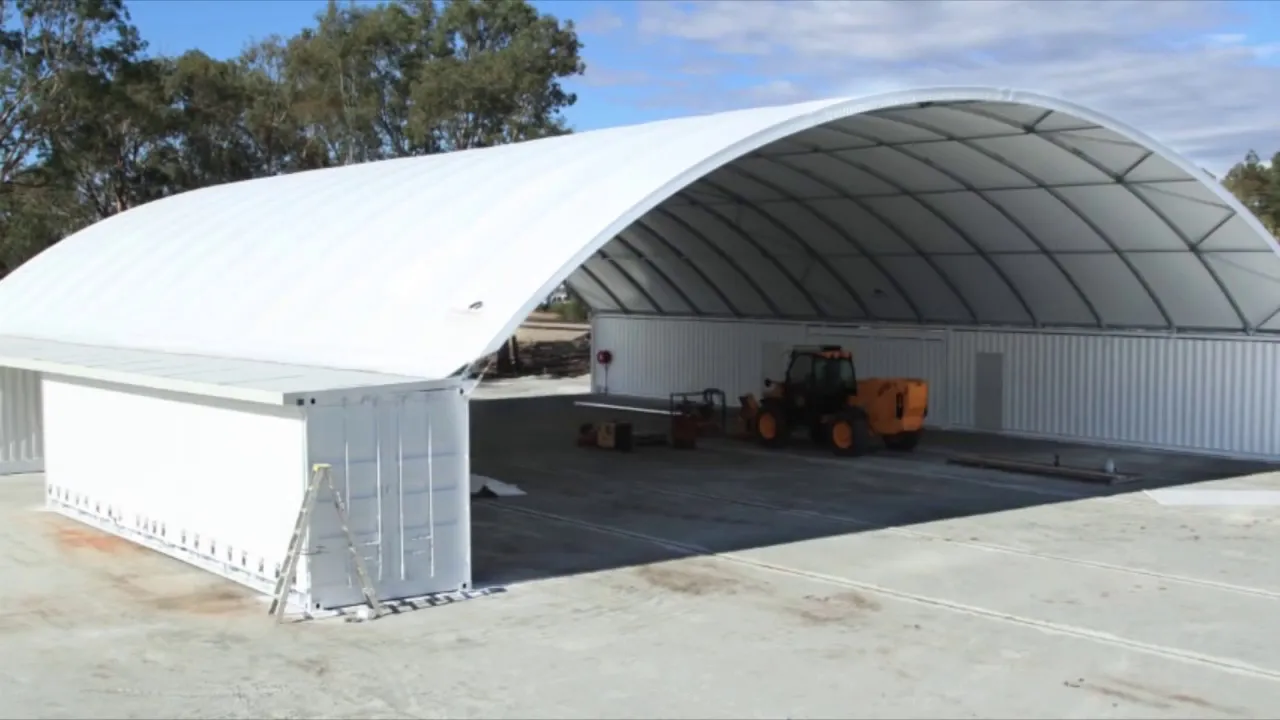
A shipping container roof (also called a container canopy, container roof kit or container shelter) is a structural canopy system designed to span the gap between two shipping containers. The containers act as the side walls and supports, and the roof covers everything in between.
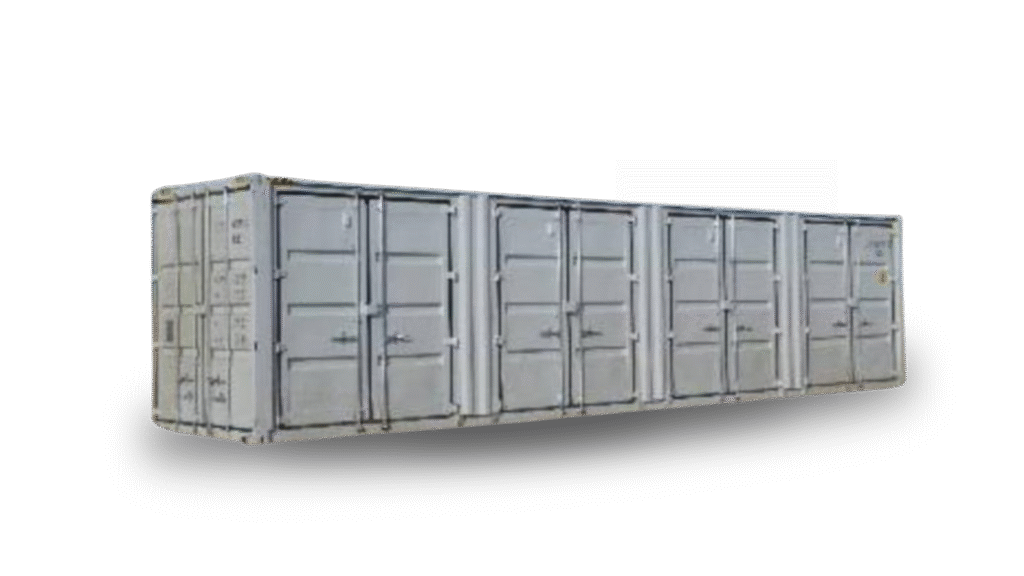
Because there are no posts in the middle, you get a clear span. A tractor, skid steer, work truck, trailer or pallet stack can move through without working around columns. The containers stay useful too: one can hold tools and parts, the other supplies or inventory, while the covered space between them becomes your loading area, repair bay or equipment shelter.
6 shipping container roof ideas
1. Fabric roof kit between two containers
This is the most common option, and the one most buyers mean when they search for a shipping container roof kit. Galvanized steel trusses mount on top of the containers and support a PVC fabric cover. It covers large areas at a lower cost per square foot than a metal building, and the fabric lets natural light in. See all our shipping container roof kits.
2. Single truss vs. double truss
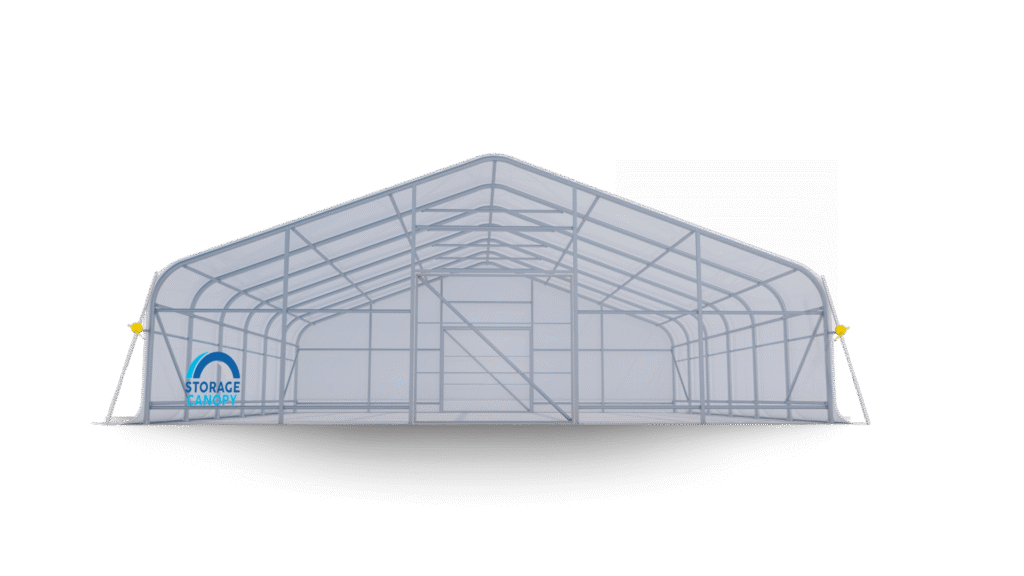
Single truss kits use one steel truss at each frame position. Double truss kits use two, which makes the frame stiffer. Double truss models cost more and are the first ones to compare if your site gets heavy snow or strong wind. Always check the documented ratings of the exact model.
3. Dome roof vs. peak roof
A dome (arched) roof is the classic Quonset-style profile: simple, strong and efficient. A peak roof has a gable shape that gives more usable height near the sides and helps rain and snow slide off. Compare the 40 x 40 ft Double Truss Dome with the 40 x 40 ft Double Truss Peak.
4. Metal roof over containers
Some owners build a metal roof, with steel sheets on purlins, across the containers. It offers high wind and snow resistance and, depending on the material, a long service life. The trade-offs: it is a fixed structure, it usually covers smaller areas, it normally needs professional installers and lead times are longer. For most yards and farms, a fabric kit is faster to set up and cheaper per square foot.
5. A roof without containers
You do not always need containers. A roof kit can be mounted on other supports, but the columns, beams, foundations and connections must be designed for the loads and your site, so contact us with your layout before buying. If you have no containers at all, a freestanding fabric building may be the better fit.
6. Close it in with end walls
Add end walls and the open canopy becomes an enclosed building: 2 containers + 1 roof kit + end walls = a new warehouse. Plan the end walls from the start if you need security, dust protection or a closed workshop, and ask our team which ones are compatible with your kit.
Fabric roof kit vs. metal roof
| Fabric roof kit | Metal roof | |
|---|---|---|
| Kit cost per sq ft | From about $2.79 | Usually higher |
| Installation | Kit with instructions, small crew | Professional installers |
| Covered area | Up to 60 x 80 ft per kit | Usually smaller |
| Can it be moved? | Yes, it can be taken down and reinstalled | No, it is fixed |
| Natural light | Yes, through the fabric | No |
| Wind and snow | Check the model ratings; double truss for tougher sites | High resistance |
How to choose the right size
Every kit name follows the same format: Width x Length x Height. For example, 40W-40L-15H means 40 ft wide, 40 ft long and 15 ft high.
- Width is the span between the two containers: 20, 26, 33, 40 or 60 ft.
- Length is how long the covered area is. 20 ft kits match 20 ft containers and 40 ft kits match 40 ft containers; 60 and 80 ft kits cover longer runs.
- Height is the height listed for the roof. Check the product page for total clearance, which also depends on what the roof sits on (a standard container is about 8.5 ft tall and a high cube about 9.5 ft).
Start with the equipment, not the containers
Measure the largest thing you need to fit under the roof (a tractor with the loader raised, a truck, an RV, a boat on its trailer) and add room to maneuver. Then choose the width and height. Confirm the exact container spacing and mounting points for your model before you place the containers.
| Kit size | Containers | Typical use |
|---|---|---|
| 20 x 20 ft | Two 20 ft containers | Small workshop, ATV and mower storage, tool area |
| 20 x 40 ft | Two 40 ft containers | Vehicle and pallet storage, loading area |
| 26 x 40 ft | Two 40 ft containers | Farm equipment, pickup trucks |
| 33 x 40 ft | Two 40 ft containers | Tractors, hay and feed storage |
| 40 x 40 ft | Two 40 ft containers | Equipment shelter, repair bay |
| 40 x 60 ft and 40 x 80 ft | Longer container runs | Large equipment, warehouse |
| 60 x 40 ft and 60 x 80 ft | Longer container runs | Commercial warehouse, fleet parking |
How much does a shipping container roof cost?
These are current kit prices from our store (November 2026). Prices are for the roof kit; containers are not included.
| Kit | Size | Price | Kit price per sq ft |
|---|---|---|---|
| Shipping Container Roof | 20 x 20 ft | From $1,629 | $4.07 |
| Container Canopy | 20 x 40 ft | From $2,229 | $2.79 |
| Shipping Container Workshop | 26 x 20 ft | From $2,229 | $4.29 |
| Container Canopies | 26 x 40 ft | From $3,410 | $3.28 |
| Quonset Hut | 33 x 40 ft | From $4,749 | $3.60 |
| Shipping Container Garage (single truss) | 40 x 40 ft | From $5,230 | $3.27 |
| Container Shelter (double truss dome) | 40 x 40 ft | $6,029 | $3.77 |
| Shipping Container Roof (single truss) | 40 x 60 ft | From $8,680 | $3.62 |
| Hoop Building (double truss peak) | 60 x 40 ft | $11,020 | $4.59 |
| Container Shelters (double truss) | 60 x 80 ft | $25,520 | $5.32 |
See all 17 sizes and options in our shipping container roof kits store.
Other costs to plan for
- The containers, if you do not have them yet.
- Site preparation: level ground and a compacted or concrete base where needed.
- Installation labor. We do not install, but we may be able to refer you to independent contractors in your area.
- Equipment to unload the kit on delivery day, such as a forklift.
- End walls, if you want to close it in.
- Permits or engineering, if your county requires them.
How to install a roof between two shipping containers
Every model has its own installation instructions, and they always come first. This is the general order of the work:
- Check local permits and the documented wind and snow ratings for your site.
- Prepare and level the ground where the containers will sit.
- Place the containers at the exact spacing your kit requires and anchor them.
- Fix the base plates to the containers with the specified hardware.
- Assemble the trusses and raise them into place.
- Pull the fabric cover over the frame, then tension and secure it as the manual describes.
- Inspect all connections and the cover tension before use.
Do not substitute bolts, welds or mounting parts without approval for your configuration.
Want to build your own roof from scratch? See our DIY shipping container roof plans.
Wind, snow and local codes
Do not assume any roof kit is rated for every climate. Ask for the documented wind and snow ratings of the exact model, compare them with your local requirements and have a qualified local professional review the installation. The containers must be anchored as well: the roof is only as secure as what holds it down.
5 mistakes to avoid before buying
- Choosing by container size instead of by the equipment you need to cover.
- Relying on the advertised width without confirming the exact container spacing and mounting points.
- Skipping the wind, snow and permit check.
- Forgetting to arrange unloading equipment for delivery day.
- Leaving the ends open when you need security or dust protection. Plan end walls from the start.
Common uses for a container roof
- Equipment and tractor shelter
- Vehicle, RV and boat storage
- Jobsite workshop and repair bay
- Farm storage for hay, feed and supplies
- Warehouse and loading area
- Covered break or assembly area for crews
- Temporary buildings for projects and events
Maintenance tips
Inspect the cover and connection points regularly, re-tension the fabric when needed, keep drainage clear and fix loose fittings or damage right away. Follow the model instructions for snow removal.
Frequently asked questions
Is shipping free, and do you ship throughout the United States?
Yes. Our shipping container roof kits ship free within the United States. Contact us with your selected model and delivery ZIP code to confirm delivery details for your location, and arrange unloading equipment before the delivery date.
What is the estimated shipping time?
Delivery timing depends on product availability, your location, and the carrier’s schedule. Contact us before ordering for an estimated timeframe for your selected kit. Coordinate installation and equipment rental after your delivery arrangements have been confirmed.
Do you do the installation?
We do not provide installation services, but we may be able to refer you to independent contractors in your area. Contact us to ask about referrals. Installation pricing, scheduling, and arrangements are agreed directly with the contractor.
The shipping company unloads the container roof kit?
Confirm unloading arrangements before your order ships. Do not assume unloading equipment or assistance is included with freight delivery. Ask us for the package dimensions and weight so you can arrange suitable equipment and confirm any additional delivery services.
Can the roof be mounted on the outside edges of the containers?
Check the installation instructions for your specific model before choosing an outside-edge mounting configuration. The mounting location affects container spacing and the covered area. Contact us with your model and proposed layout to confirm compatibility before positioning the containers.
How do you attach a roof to a shipping container?
The attachment method depends on the roof kit’s base plates, mounting hardware, and installation specifications. Follow the instructions for your exact model, and have your installer confirm the required connections. Do not substitute bolts, welds, or mounting components without approval for that configuration.
Are shipping container roof kits hurricane-rated?
Do not assume a roof kit is hurricane-rated. Suitability depends on documented wind ratings for the specific model, its mounting system, the supporting containers, and site anchoring. Request the available technical documentation and have a qualified local professional assess whether the system meets your project’s requirements.
Can multiple shipping container roof kits be connected?
Contact us before planning a connected installation. Matching dimensions alone do not establish compatibility. Any connection between kits needs an appropriate structural and weather-sealing detail. Do not cut, sew, or modify the covers or frames without instructions approved for the specific system.
How far apart should I separate the containers to prepare the installation?
Use the installation drawing for your exact roof kit to determine container spacing and mounting points. Do not rely on the advertised roof width alone. Confirm the required measurements before placing or anchoring the containers.
How can I help prevent leaks?
Follow the model’s instructions for cover positioning, tensioning, overlaps, and drainage. Inspect the cover and connection points regularly, and address loose fittings or damage promptly. Ask your installer about compatible flashing or sealing details where needed.
Can I install the roof kit without shipping containers?
An alternative support system requires confirmation that it is compatible with the roof kit. Columns, beams, foundations, and connections must be designed for the intended loads and site conditions. Contact us with your proposed layout before purchasing a kit for this type of installation.
Should I choose a single-truss or double-truss roof kit?
Compare the documented specifications of the individual models, including span, wind and snow loads, mounting requirements, and intended use. A double-truss label alone does not establish suitability for your site. Have your installer or engineer review the available specifications before choosing.
What materials are used in the roof kits?
Check the selected product’s specifications for frame material, protective finish, cover material, and fabric weight. These details may vary between models and configurations. Contact us if you need clarification about the materials included with a particular kit.
Can I use my own shipping provider?
Contact us before booking your own carrier. We will need to confirm pickup arrangements, package dimensions and weight, and any required shipping documents. Wait for confirmation before scheduling collection.
How resistant is the fabric shelter?
Fabric performance depends on the specific material, installation, exposure, and maintenance. Review the selected model’s documented specifications and care instructions. Claims about UV resistance, fire performance, or weather resistance should be checked against the documentation for that exact cover.
How big is the packaging box of the container roof kit?
Package dimensions and weight vary by model. Check the product page’s Additional Information section, or contact us for the shipping specifications. Confirm these details before arranging transportation, unloading equipment, or storage.
Find your shipping container roof kit
17 kits from 20 x 20 ft to 60 x 80 ft, ready to buy online with free shipping in the USA. Need help choosing a size? Call us or ask for a quote.
